

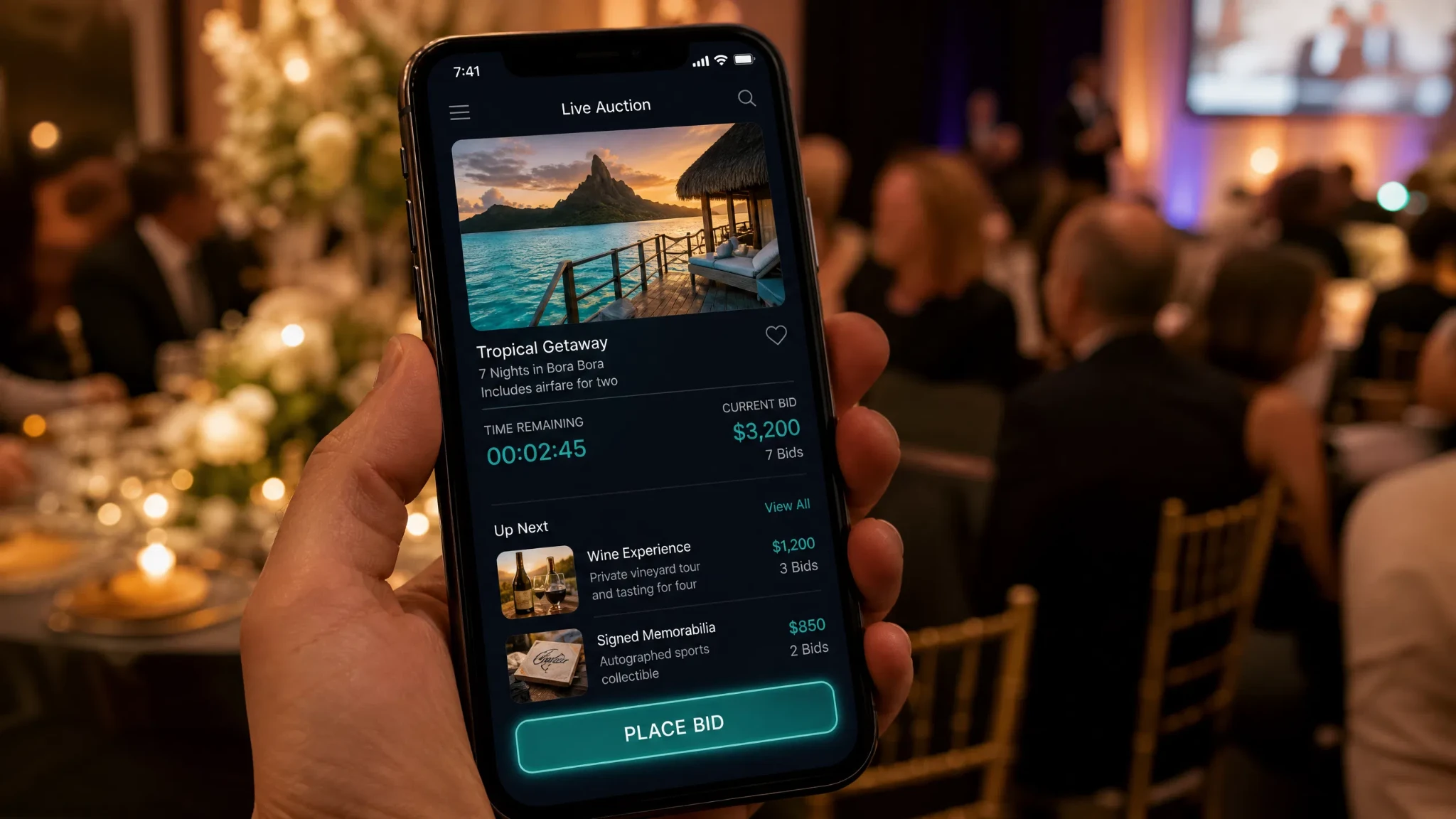
Mobile Bidding and Fundraising Auction Software: Why Going Digital Raises More Money
Paper bid sheets have a ceiling. A donor who steps away from a table to get a drink misses the last-minute bidding on an item they wanted. Someone at the back of the room never sees the leaderboard update. A bidder who left early doesn’t know they could have won with one more raise. Every one of those moments is lost revenue.
Digital bidding removes most of those friction points. Purpose-built fundraising auction software with mobile bidding capability keeps donors engaged throughout an event, pulls in participants who aren’t physically present, and extends competitive bidding beyond what a paper system can sustain. The evidence that this raises more money is consistent across event types and organization sizes.
What Mobile Bidding for Fundraising Auctions Actually Changes
The core difference between paper and mobile bidding is not technology for its own sake. It is the removal of physical constraints on participation. A donor sitting at table twelve doesn’t need to walk to a bid sheet to stay competitive. Someone who left at 9 PM can still win an item that closes at 10. A major donor watching remotely from another city can participate as fully as someone standing in the room.
Each of these scenarios represents a bid that paper systems lose by default. Mobile bidding captures them. The cumulative effect across a full evening of bidding is meaningful, particularly on high-value items where a small number of motivated bidders compete and the difference between winning and losing often comes down to whether an outbid alert reaches someone in time.
The behavioral dynamic also changes. When a donor receives a notification that they have been outbid, the instinct to respond is immediate. Paper systems have no equivalent mechanism. A bidder who is outbid on a paper sheet may not notice for twenty minutes, by which point the competitive urgency has passed. Push notifications recreate that urgency in real time, which is why outbid notification delivery is one of the strongest predictors of per-item revenue in digital auctions.
How Going Digital Increases Total Event Revenue
The revenue impact of digital bidding shows up in multiple places across a fundraising event, not just in per-item auction results. Understanding where the gains come from helps organizations make the case internally for investing in the right software.
Average winning bid amounts tend to increase when mobile bidding is in use. More participants competing on each item pushes prices higher, and the ability to bid from anywhere in the room means high-value items attract more active bidders than they would if participation required walking to a specific location. Items that might close with two or three bids on paper often see eight to twelve bids digitally on the same lot.
The time savings are also financially significant. Check-in and checkout processes that take an hour with paper can be reduced to minutes with digital registration and automated payment processing. Staff time freed from managing bid sheets and calculating totals can be redirected to donor stewardship during the event, which has its own revenue implications. Organizations that have shifted to digital bidding consistently report that events run more smoothly and that staff spend more time with donors rather than managing logistics.
Core Features That Separate Effective Mobile Bidding Platforms From Basic Ones
Not all mobile bidding platforms deliver the same results. The features that drive revenue are specific, and organizations that evaluate platforms on general feature lists rather than these specifics often end up with software that underperforms.
The registration experience matters more than most organizations expect. A donor who encounters friction during mobile registration — a slow load time, a form that doesn’t work on their phone, a login step that requires too many fields — will fall back on paper or disengage entirely. Registration should complete in under two minutes on any smartphone, without requiring an app download.
- Real-time bid updates without page refresh. Donors watching an item should see competing bids appear instantly, not after a manual refresh. Platforms using older polling architecture rather than WebSocket connections will feel sluggish to participants, which reduces engagement and bid frequency.
- Automated outbid notifications via text and email. Text notifications have significantly higher open rates than email, particularly during a live event. The platform should send outbid alerts through both channels and allow donors to configure their preference during registration.
- Fund-a-need and paddle raise integration. Fundraising events typically combine silent auctions with direct giving moments. A platform that handles both within a single donor interface keeps participants in one place rather than requiring them to switch between a bidding app and a separate giving page.
- Automated payment collection at close. When the auction closes, winning bidders should receive an immediate payment request that can be completed from their phone. Platforms that require a checkout line or a manual invoicing step after the event lose payments and create follow-up work.
Platforms that handle all four of these features cleanly raise more money per event than those that approximate them. The differences show up most clearly on high-value items and during the final minutes of bidding when competitive engagement is highest.
Virtual and Hybrid Event Capability for Fundraising Auctions
In-person events are not the only context where mobile bidding software matters. Organizations that run virtual or hybrid fundraising auctions face a different set of requirements, and not every platform serves both formats well.
Virtual events require live streaming integration. Donors watching a live auction from home need video of the auctioneer and the items, synchronized with the bidding interface. If the video lags behind the bidding or runs through a separate platform that donors have to manage alongside the auction, the experience breaks down quickly. Platforms built for hybrid use integrate the live stream and the bidding interface in a single view.
Hybrid events add the complexity of synchronizing in-room and remote participants on the same lots. Remote donors need to feel that they are competing fairly with people in the room, which requires that bid updates reach both audiences simultaneously and that the auctioneer has visibility into online bids in real time. Organizations that run hybrid galas should test this synchronization explicitly during any platform evaluation rather than assuming it works from a feature description.
What to Look for When Choosing Fundraising Auction Software for Mobile Bidding
Selecting the right platform for a fundraising event involves evaluating more than the bidding interface. The full event experience includes check-in, item browsing, bidding, payment, and post-event donor communication. Platforms that handle the full lifecycle within one system are easier to manage and produce cleaner data for follow-up.
Support during the live event is one of the most underweighted factors in platform selection. A technical issue during the final thirty minutes of an auction can cost more in lost bids than the annual platform fee. Organizations should ask vendors directly how support is provided during live events, what the response time commitment is, and whether a dedicated event support contact is available during the auction window.
- Donor data ownership and export. The bidding data from your events belongs to your organization. Platforms that restrict data export or make it difficult to access bidder history after an event create dependency and limit your ability to use that data for future cultivation.
- Consignor and item management tools. Events with donated items from multiple consignors need a system for tracking item sources, setting minimum bids, and attributing proceeds. Platforms that handle consignment within the same system as bidding eliminate a manual reconciliation step after the event.
- Post-event reporting for donor stewardship. A clean report of who bid on what, who won, what they paid, and what they didn’t win gives your development team a starting point for personalized follow-up. Platforms that produce only basic financial summaries leave cultivation intelligence on the table.
The organization that treats software selection as a revenue decision rather than a technology decision will evaluate these factors carefully and select a platform based on what it produces in results, not just what it costs per event.
Conclusion
Mobile bidding raises more money than paper systems because it removes the physical constraints that limit participation and competitive bidding. The gains show up in per-item results, checkout efficiency, and donor engagement across the full event. The platforms that deliver the best outcomes share a set of specific capabilities: real-time bid updates, reliable outbid notifications, seamless payment collection, and live event support that is actually available when something goes wrong. Evaluate those capabilities directly during any platform trial, and prioritize what produces revenue over what looks impressive in a demo.